
Nothing disrupts the comfort of home quite like discovering unwanted pests. It often begins with subtle clues—a rustling sound behind the cabinets, tiny droppings near the pantry, or a cockroach darting into a crack when the lights come on. Suddenly, your home no longer feels like the peaceful sanctuary it once was.
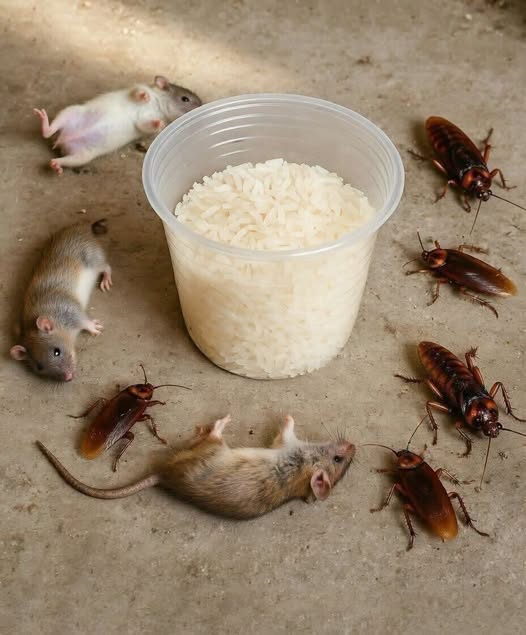
When faced with rodents or cockroaches, many homeowners search for affordable alternatives to professional pest control. One popular idea shared online involves using ordinary rice in homemade pest remedies. Some claim that rice, combined with common household ingredients, can help control infestations naturally.
But how much of this advice is supported by science? Is rice really an effective solution, or are these methods based more on tradition and internet folklore?
In this article, we’ll explore the most common rice-based pest control remedies, examine what scientific evidence says, discuss potential safety concerns, and highlight the most reliable ways to keep your home pest-free.
Why Rice Is Included in Homemade Pest Remedies
Rice itself is not poisonous to rats or cockroaches. Instead, it serves as an inexpensive food source that attracts pests toward other ingredients.
Many homemade recipes use rice because it is:
Easy to find
Affordable
Odor-neutral
Appealing to certain rodents and insects when mixed with sweet ingredients
In most cases, rice functions as bait rather than the active pest-control ingredient.
Homemade Rice Remedies for Cockroaches
One of the most commonly shared recipes combines:
Cooked rice
Sugar
Boric acid powder
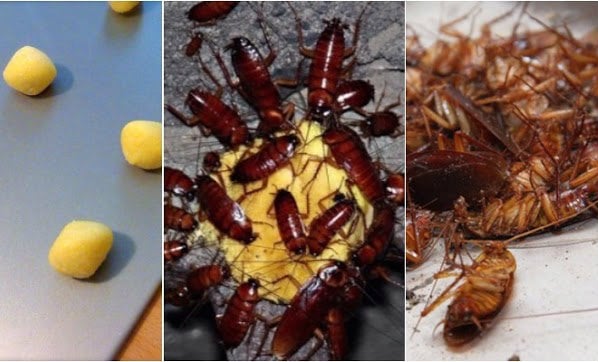
The sugar and rice attract cockroaches, while boric acid acts as the active ingredient.
How Boric Acid Works
Boric acid has long been used in commercial pest control.
When cockroaches consume small amounts, the compound damages their digestive system and affects their nervous system. Because its effects are relatively slow, exposed insects may return to their hiding places before dying, potentially exposing other cockroaches through contact.
This delayed action makes boric acid one of the more effective ingredients used against cockroaches when applied correctly.
However, the effectiveness depends on:
Proper placement
Small quantities
Keeping competing food sources away
Maintaining dry conditions
Simply placing bowls of rice around the home will not eliminate cockroaches.
Homemade Rice Remedies for Rats and Mice
Another widely circulated remedy involves mixing uncooked rice with ingredients such as:
Baking soda
Plaster powder
Sugar
Cocoa powder
The theory is that rodents eat the attractive mixture, leading to internal digestive problems.
However, these methods are far less reliable than many online articles suggest.
Scientific studies have not established rice-based homemade mixtures as dependable methods for controlling rodent populations.
Professional pest management organizations generally recommend proven trapping systems or regulated rodenticides rather than homemade mixtures.
Does Science Support These Rice Remedies?
The answer depends on which ingredient you’re discussing.
Rice Alone
There is no scientific evidence that plain rice kills rats, mice, or cockroaches.
Rice is simply food.
Without another active ingredient, it does not control pests.
Boric Acid
Boric acid has extensive scientific support as an effective insecticide for cockroaches when used correctly.
It has been used for decades in integrated pest management programs.
Baking Soda for Rodents
Evidence supporting baking soda as an effective rodent control method remains extremely limited.
Many pest experts consider it unreliable because rodents often avoid consuming enough of it to have any meaningful effect.
Plaster Powder Mixtures
Claims involving plaster powder are largely anecdotal and are not recommended by pest-control professionals.
These mixtures may create unnecessary risks without consistently solving infestations.
Safety Concerns You Should Never Ignore
While homemade remedies may appear safer than commercial chemicals, they still require caution.
Boric Acid Risks
Although boric acid has relatively low toxicity when used properly, it can still be harmful if accidentally ingested by:
Children
Dogs
Cats
Other household pets
It should never be placed where curious children or animals can reach it.
Always wash your hands thoroughly after handling boric acid.
Homemade Rodent Baits
Any bait designed to harm rodents carries potential risks.
Rodents that consume bait may:
Die inside walls
Create unpleasant odors
Attract insects
Be consumed by wildlife or pets
These secondary effects are often overlooked in online tutorials.
Better Ways to Prevent Cockroaches
Prevention remains the most effective long-term solution.
Eliminate Food Sources
Store dry foods in airtight containers.
Clean crumbs promptly.
Avoid leaving pet food out overnight.
Wipe kitchen surfaces regularly.
Remove Water Sources
Cockroaches require moisture to survive.
Repair leaking pipes.
Dry sinks before bedtime.
Improve ventilation in damp rooms.
Seal Entry Points
Inspect your home for:
Cracks around plumbing
Gaps beneath doors
Openings around windows
Small wall crevices
Sealing these areas helps reduce new infestations.
Use Proven Baits
Commercial cockroach bait stations are specifically formulated to attract roaches while reducing exposure risks to people.
When used according to the manufacturer’s instructions, they often provide more consistent results than homemade mixtures.
Better Ways to Prevent Rats and Mice
Rodent prevention focuses on denying access to food and shelter.
Secure Food Storage
Store grains, cereal, and pet food in sealed containers.
Avoid leaving food on countertops overnight.
Keep garbage bins tightly closed.
Remove Nesting Areas
Clear clutter from storage rooms.
Trim vegetation touching your home.
Keep firewood away from exterior walls.
Close Entry Points
Mice can enter through openings as small as a dime.
Inspect:
Foundation cracks
Roof vents
Pipe openings
Garage doors
Seal gaps with appropriate materials such as steel wool combined with sealant where appropriate.
Consider Humane Traps
For small infestations, humane live traps or snap traps placed strategically are generally recommended over homemade bait mixtures.
Why Homemade Remedies Remain Popular
Despite mixed scientific evidence, homemade pest-control ideas continue to spread widely online.
Several reasons explain their popularity.
Low Cost
Professional extermination services can be expensive.
Homemade recipes use ingredients already found in many kitchens.
Simplicity
Mixing household items feels straightforward compared to researching specialized products.
Desire for Natural Alternatives
Many people hope to reduce chemical exposure inside their homes.
Although “natural” does not always mean safer or more effective, this preference continues to drive interest.

When Professional Pest Control Is the Better Choice
Some situations require expert assistance.
Consider contacting a licensed pest-control professional if you notice:
Large numbers of cockroaches during daylight
Frequent rodent sightings
Extensive droppings
Damage to wiring or insulation
Persistent infestations despite repeated cleaning
Professionals can identify hidden nesting areas and recommend targeted solutions that address the root cause of the problem.
Integrated Pest Management: The Most Effective Long-Term Strategy
Modern pest control increasingly relies on Integrated Pest Management (IPM).
Rather than depending on a single treatment, IPM combines multiple approaches:
Routine inspections
Sanitation improvements
Exclusion methods
Monitoring
Targeted pesticide use only when necessary
This balanced approach minimizes chemical exposure while providing effective long-term control.
Common Myths About Rice and Pest Control
Several misconceptions frequently circulate online.
Myth: Rice Alone Eliminates Cockroaches
False.
Rice simply attracts pests and has no insecticidal properties.
Myth: Every Homemade Recipe Is Safe
False.
Some ingredients may pose risks to pets, children, or wildlife.
Myth: Natural Means Harmless
False.
Many naturally occurring substances can still be toxic when improperly handled.
Myth: One Treatment Solves Every Infestation
False.
Successful pest management almost always requires ongoing prevention and maintenance.
A Smarter Approach to Pest-Free Living
Rice may have a place in certain homemade bait recipes, but it is not a miracle solution for eliminating rats or cockroaches. In most cases, its primary role is to attract pests rather than control them.
Among the commonly discussed ingredients, boric acid has the strongest scientific support for cockroach management when used carefully and according to safety guidelines. Homemade rodent remedies involving rice, baking soda, or plaster, however, remain largely unsupported by reliable scientific evidence.
Ultimately, the best defense against pests begins with prevention: maintaining a clean home, storing food securely, eliminating moisture, sealing entry points, and responding promptly to early signs of activity. When infestations become widespread or persistent, consulting a qualified pest-control professional is often the safest and most effective option.
Our curiosity naturally leads us to search for clever household solutions, and some traditional ideas can offer useful insights. However, combining curiosity with evidence-based information helps us make better decisions that protect both our homes and the people—and pets—we care about.
Sources
Centers for Disease Control and Prevention (CDC). Healthy Housing Reference Manual: Integrated Pest Management.
U.S. Environmental Protection Agency (EPA). Integrated Pest Management (IPM) Principles.
National Pesticide Information Center (NPIC). Boric Acid General Fact Sheet.
University of California Agriculture and Natural Resources. Integrated Pest Management Program: Cockroaches.
Cornell University Cooperative Extension. Household Pest Management Resources.
World Health Organization (WHO). Public Health Significance of Urban Pests.
