
Few things are more relaxing than taking a walk along the beach with a loyal dog. The sound of the waves, the fresh sea breeze, and endless stretches of sand make for a peaceful outing. Dogs, with their incredible sense of smell and curiosity, often discover interesting shells, driftwood, or marine life long before their owners notice them.
Imagine, however, that your normally fearless dog suddenly stops. Its ears perk up, its posture stiffens, and it refuses to move closer to an unusual object resting on the shoreline. Naturally, you become curious too.
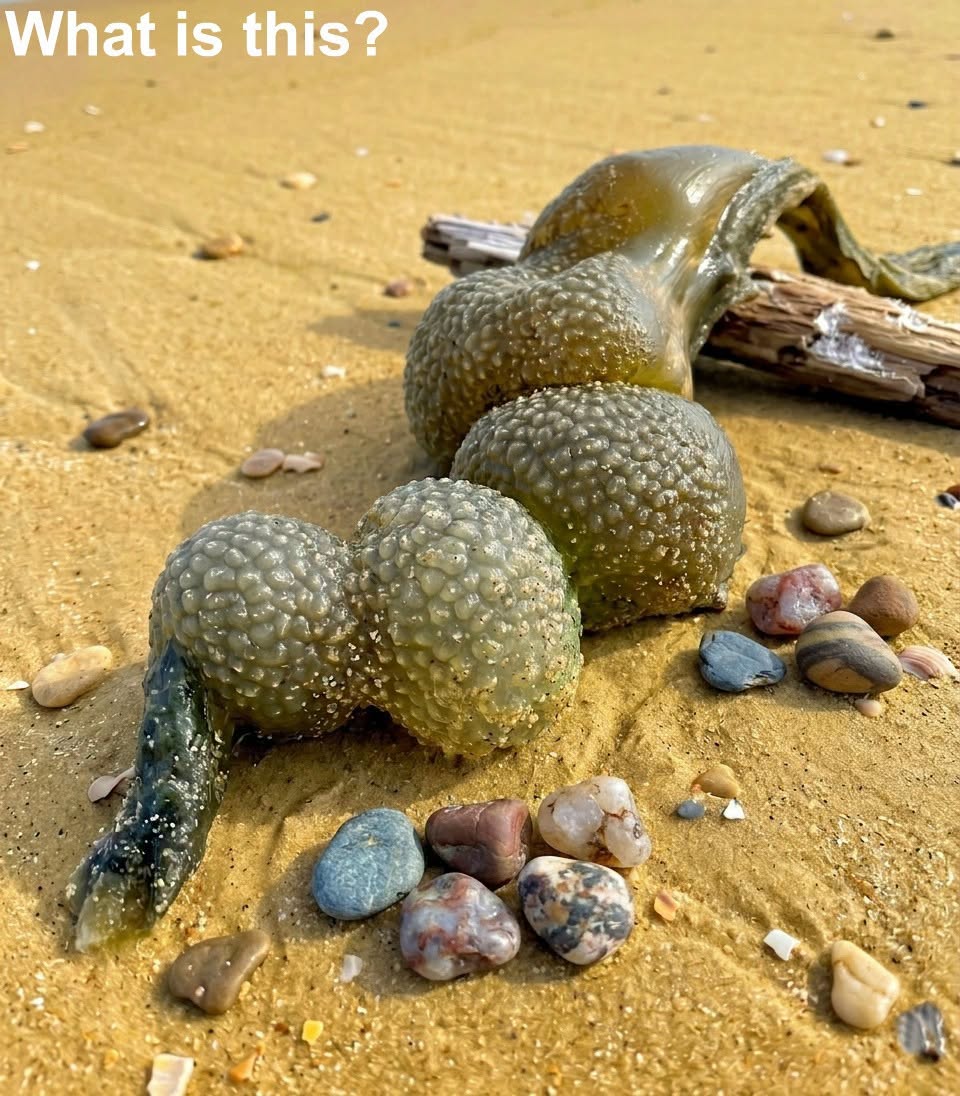
At first glance, the object appears strange. It looks swollen, covered with bubble-like structures, and has an unusual odor. For a brief moment, it might seem like something unfamiliar or even alarming.
After a little research, though, the mystery becomes much simpler. The object is likely Sargassum, a type of floating brown seaweed that plays an important role in marine ecosystems despite its unusual appearance.
Understanding what Sargassum is can help beachgoers appreciate this remarkable part of nature instead of fearing it.
What Is Sargassum?
Sargassum is a genus of brown macroalgae commonly known as brown seaweed.
Unlike many seaweeds that grow attached to rocks along the ocean floor, several Sargassum species spend their entire lives floating on the ocean’s surface.
They drift with currents, forming large floating mats that travel across tropical and subtropical seas.
These floating habitats support a wide variety of marine life and contribute to healthy ocean ecosystems.

Why Does It Look So Strange?
One of Sargassum’s most distinctive features is the presence of small, round air-filled structures called pneumatocysts.
These tiny gas-filled bladders help keep the seaweed buoyant, allowing sunlight to reach its leaf-like blades for photosynthesis.
When washed ashore, these air sacs can give the seaweed an unusual appearance that many people mistake for eggs, bubbles, or even living creatures.
Combined with natural decomposition, the tangled mass may appear unfamiliar to anyone encountering it for the first time.
Why Dogs React to It
Dogs experience the world primarily through smell.
Their sense of smell is estimated to be tens of thousands of times more sensitive than that of humans.
When Sargassum begins decomposing after washing onto beaches, naturally occurring bacteria break down organic material and release sulfur-containing compounds.
These compounds produce a strong odor that humans may notice—but dogs detect it much earlier and much more intensely.
A cautious reaction does not necessarily mean the seaweed is dangerous; it simply reflects your dog’s remarkable sensory abilities.
Why Does Sargassum Wash Ashore?
Ocean currents constantly transport floating seaweed across vast distances.
Several natural factors contribute to large accumulations reaching beaches:
Ocean currents
Seasonal winds
Storm activity
Tides
Changes in water temperature
Some years produce much larger arrivals than others depending on oceanic conditions.
Scientists continue studying these seasonal patterns to better understand why coastal regions experience varying amounts of Sargassum.

The Ecological Importance of Sargassum
Although beachgoers sometimes view washed-up seaweed as a nuisance, Sargassum performs valuable ecological functions while floating at sea.
Its dense mats provide habitat for many marine organisms, including:
Small fish
Sea turtles
Crabs
Shrimp
Marine snails
Numerous microscopic organisms
Some species spend nearly their entire lives within these floating ecosystems.
For young marine animals especially, Sargassum offers shelter from predators and abundant feeding opportunities.
What Happens After It Reaches Shore?
Once stranded on beaches, Sargassum gradually decomposes.
During this natural process it returns nutrients to coastal ecosystems.
Beach organisms, insects, and microorganisms participate in breaking down the organic material.
In some locations, municipalities remove excessive accumulations because large amounts can affect tourism or create unpleasant odors.
However, moderate amounts often remain as part of natural coastal processes.
Can Sargassum Be Harmful?
Fresh Sargassum itself is generally not considered harmful to people.
However, decomposing seaweed can release hydrogen sulfide and ammonia gases, particularly when very large accumulations remain on beaches for extended periods.
These gases are responsible for the distinctive smell sometimes associated with decaying seaweed.
People with respiratory sensitivities may prefer avoiding prolonged exposure to large decomposing piles.
It is also wise to avoid handling any unfamiliar marine material without knowing what it is.
Why Nature Sometimes Looks Unfamiliar
Humans naturally become cautious when encountering unfamiliar objects.
Throughout history, recognizing unknown plants, animals, or environmental conditions has helped people stay safe.
Many natural objects can appear unusual simply because we encounter them infrequently.
Learning about them often transforms uncertainty into appreciation.
Sargassum is an excellent example of how scientific understanding can replace mystery with curiosity.

The Role of Dogs as Observant Companions
Dogs frequently notice environmental changes before humans do.
Their heightened senses allow them to detect:
New scents
Animal activity
Changes in weather
Unusual sounds
Marine odors
While their reactions should not automatically be interpreted as signs of danger, they often encourage us to pay closer attention to our surroundings.
In this way, dogs become excellent companions for exploring nature.
Tips for Encountering Sargassum on the Beach
If you come across Sargassum during a beach walk, consider a few simple precautions.
Observe it without disturbing wildlife that may be sheltering within it.
Keep dogs from eating decomposing seaweed, as consuming unfamiliar marine material may upset their digestive system.
Wash hands after handling natural debris.
Respect any local guidance regarding beach conditions.
Most importantly, take the opportunity to appreciate one of the ocean’s remarkable natural phenomena.
Why Scientists Study Sargassum
Researchers continue investigating Sargassum because it provides valuable information about ocean health.
Studies focus on topics such as:
Ocean circulation
Climate variability
Marine biodiversity
Coastal ecosystems
Nutrient cycling
Understanding how floating seaweed moves across oceans helps scientists better understand broader environmental processes.
Conclusion
What first appears to be a mysterious object on the beach often turns out to be a fascinating example of nature’s complexity. Sargassum seaweed may look unusual with its tangled branches and air-filled bladders, but it serves an important ecological role by supporting countless marine species and contributing to healthy coastal environments. A dog’s cautious reaction reflects its extraordinary senses rather than proof that the seaweed is dangerous.
Human curiosity often begins with uncertainty. The unfamiliar can seem mysterious until knowledge reveals its true nature. By learning about remarkable organisms like Sargassum, we gain a deeper appreciation for the natural world and discover that many of its greatest wonders are hiding in plain sight along the shoreline.
Sources
National Oceanic and Atmospheric Administration (NOAA). What Is Sargassum?
Smithsonian Ocean. Floating Marine Ecosystems.
National Geographic. Seaweed and Coastal Ecosystems.
Woods Hole Oceanographic Institution. Research on Sargassum Blooms.
Encyclopaedia Britannica. Brown Algae (Phaeophyceae).
International Union for Conservation of Nature (IUCN). Marine Habitat Conservation.
