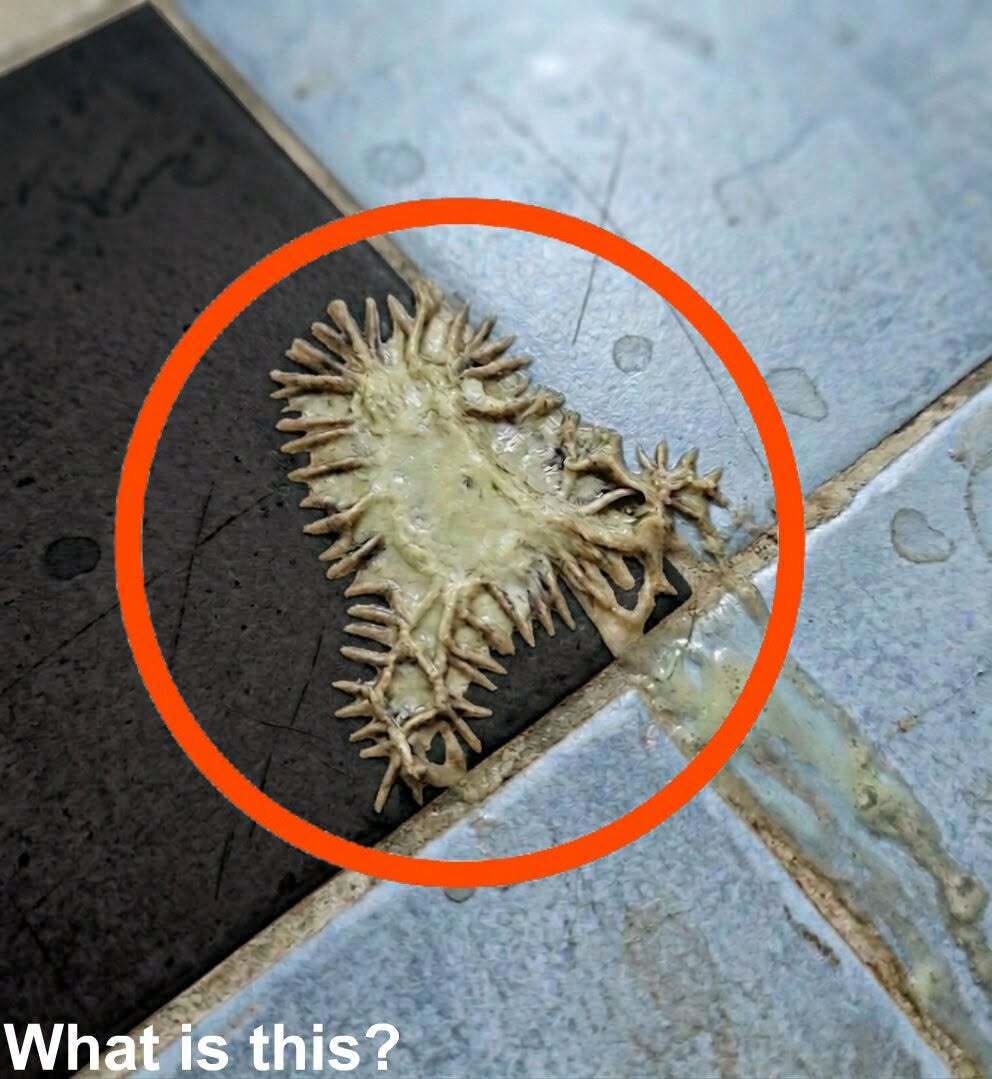

Imagine walking into your bathroom for an ordinary evening routine and noticing something unusual near the edge of the floor. At first glance, it looks almost alive—a pale, branching structure spreading across the tile in an intricate pattern.
It’s easy to wonder whether it’s an insect nest, an unusual fungus, or something that somehow appeared overnight.
Many homeowners have shared similar experiences online after discovering mysterious formations in damp areas of their homes. In numerous cases, the surprising culprit turns out to be slime mold, a fascinating organism that has puzzled scientists and nature enthusiasts for generations.
Although its appearance may seem unsettling, slime mold is usually more interesting than dangerous.
What Is Slime Mold?
Despite its name, slime mold is not actually a true mold.
Instead, it belongs to a unique group of organisms known as plasmodial slime molds (class Myxogastria). Scientists have long studied these organisms because they behave differently from plants, animals, fungi, and bacteria.
Slime molds spend part of their lives as a single giant cell containing many nuclei. During this stage, they slowly move across surfaces while searching for microscopic food sources.
Their unusual biology has made them a favorite subject of scientific research.
Why Does Slime Mold Appear Indoors?
Slime mold develops when environmental conditions are favorable.
Bathrooms, basements, crawl spaces, and laundry rooms often provide ideal conditions because they may have:
-
High humidity
-
Damp surfaces
-
Limited airflow
-
Organic debris
-
Bacteria and microorganisms
These conditions create an environment where slime molds can temporarily grow.
In many cases, they appear after periods of increased moisture or humidity.

Why Does It Look So Strange?
One reason slime mold captures people’s attention is its remarkable appearance.
Depending on the species, it may resemble:
-
Branching veins
-
Delicate roots
-
Foam
-
Tiny coral
-
Networks of threads
-
Bright yellow patches
-
White webs
Its intricate patterns often appear carefully designed, even though they develop naturally.
Scientists continue studying how slime molds organize these complex networks while searching for food.
Can Slime Mold Move?
Surprisingly, yes.
Although movement is extremely slow, slime mold is capable of changing shape and gradually expanding across a surface.
It moves by flowing its internal contents through its network-like body.
This allows it to explore its surroundings while seeking bacteria, fungi, and tiny organic particles that serve as food.
The movement is so gradual that people rarely notice it directly, but time-lapse photography clearly reveals the process.
Is Slime Mold Dangerous?
For most households, slime mold is considered harmless.
It generally does not:
-
Bite people
-
Damage tile or stone
-
Spread infectious diseases
-
Attack healthy building materials
However, its presence usually indicates excess moisture that should be addressed.
Although slime mold itself is not considered a major household hazard, persistent damp conditions may encourage the growth of other microorganisms that homeowners should manage appropriately.
Why Bathrooms Attract Slime Mold
Bathrooms naturally produce moisture through:
-
Hot showers
-
Running water
-
Steam
-
Condensation
-
Minor plumbing leaks
If ventilation is limited, humidity can remain elevated for extended periods.
Combined with microscopic organic material, these conditions allow slime mold to appear unexpectedly.
Common Places Where Slime Mold Appears
Besides bathrooms, slime mold is frequently found in:
-
Mulch
-
Gardens
-
Compost piles
-
Decaying logs
-
Leaf litter
-
Greenhouses
-
Damp basements
-
Crawl spaces
Outdoor appearances are much more common than indoor ones.

How to Remove Slime Mold Safely
Removing slime mold is usually straightforward.
Recommended steps include:
-
Wear disposable gloves if preferred.
-
Wipe the material away using paper towels or a disposable cloth.
-
Clean the surface with household soap and water or an appropriate household cleaner.
-
Dispose of cleaning materials properly.
-
Dry the area thoroughly.
Improving ventilation afterward helps reduce the likelihood of future growth.
Preventing Slime Mold Indoors
The best long-term solution is reducing excess moisture.
Helpful practices include:
-
Using bathroom exhaust fans
-
Repairing plumbing leaks
-
Drying wet surfaces
-
Improving airflow
-
Running a dehumidifier if needed
-
Cleaning areas where organic debris accumulates
Maintaining lower humidity creates conditions that are much less favorable for slime mold development.
Why Scientists Study Slime Mold
Although it appears simple, slime mold has demonstrated surprisingly sophisticated behavior.
Researchers have found that certain species can:
-
Locate efficient pathways between food sources
-
Adapt to changing environments
-
Solve simple spatial problems
-
Form complex transportation networks
Because of these abilities, slime mold has been studied in fields including:
-
Biology
-
Computer science
-
Robotics
-
Network design
-
Artificial intelligence
Its ability to organize without a brain continues to fascinate researchers around the world.
Common Myths About Slime Mold
Several misconceptions surround these unusual organisms.
Myth: Slime Mold Is a Fungus
Although it produces spores like fungi, slime mold belongs to a separate group of organisms with its own unique life cycle.
Myth: It Is Highly Dangerous
Most household slime molds are considered harmless and primarily indicate damp environmental conditions.
Myth: It Appears Because a Home Is Dirty
Slime mold is attracted mainly by moisture and microscopic food sources.
Even clean homes may occasionally experience temporary growth if humidity becomes sufficiently high.
Appreciating Nature’s Unexpected Visitors
Finding slime mold indoors can certainly be surprising.
Its unusual appearance often sparks curiosity because it resembles something from science fiction more than everyday household life.
Yet this remarkable organism reminds us how diverse and adaptable life can be.
Even the smallest corners of our homes occasionally intersect with the fascinating processes occurring throughout the natural world.
Conclusion
Discovering a strange branching growth on a bathroom floor can certainly be unexpected, but in many cases the explanation is both simple and scientifically fascinating. Slime mold is a unique organism that thrives in damp environments, feeding on microscopic organic material rather than causing harm to people or homes. While its unusual appearance may seem startling at first, it is generally considered more of a curiosity than a serious concern.
Managing indoor humidity, improving ventilation, and promptly cleaning damp areas are usually enough to discourage future growth. At the same time, slime mold offers a remarkable glimpse into the complexity of nature, demonstrating behaviors that continue to interest scientists studying biology, problem-solving, and ecological systems.
Human curiosity often begins with unexpected discoveries in familiar places. Sometimes what first appears mysterious turns out to be an opportunity to learn more about the extraordinary organisms quietly sharing our world, reminding us that even ordinary homes can reveal fascinating lessons about nature.
Sources
Smithsonian National Museum of Natural History. Slime Molds and Biodiversity.
Encyclopaedia Britannica. Slime Mold.
National Park Service. Slime Molds in Nature.
University of California Museum of Paleontology. Introduction to Slime Molds.
Royal Botanic Gardens, Kew. Myxomycetes (Slime Molds).
American Phytopathological Society. Understanding Slime Molds.
