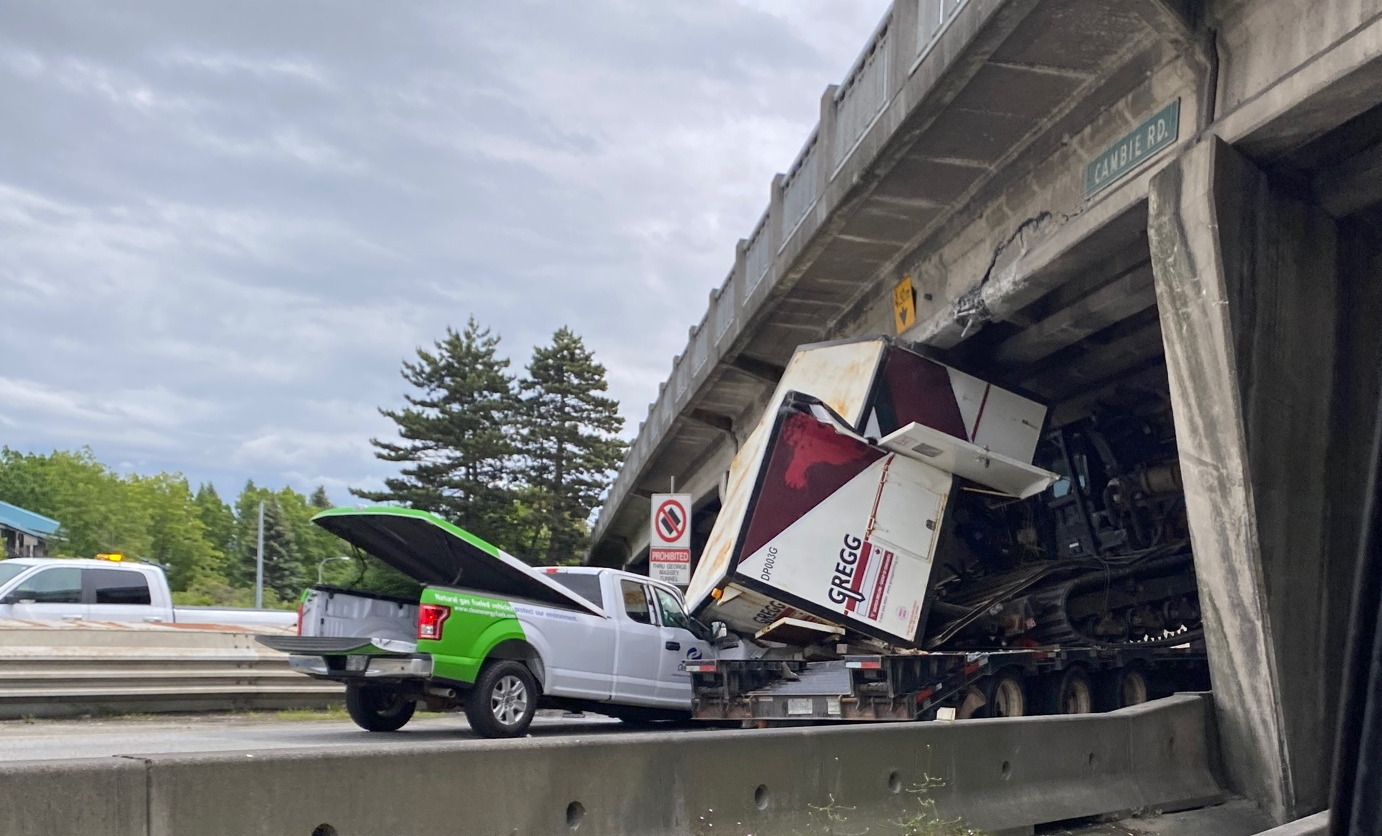

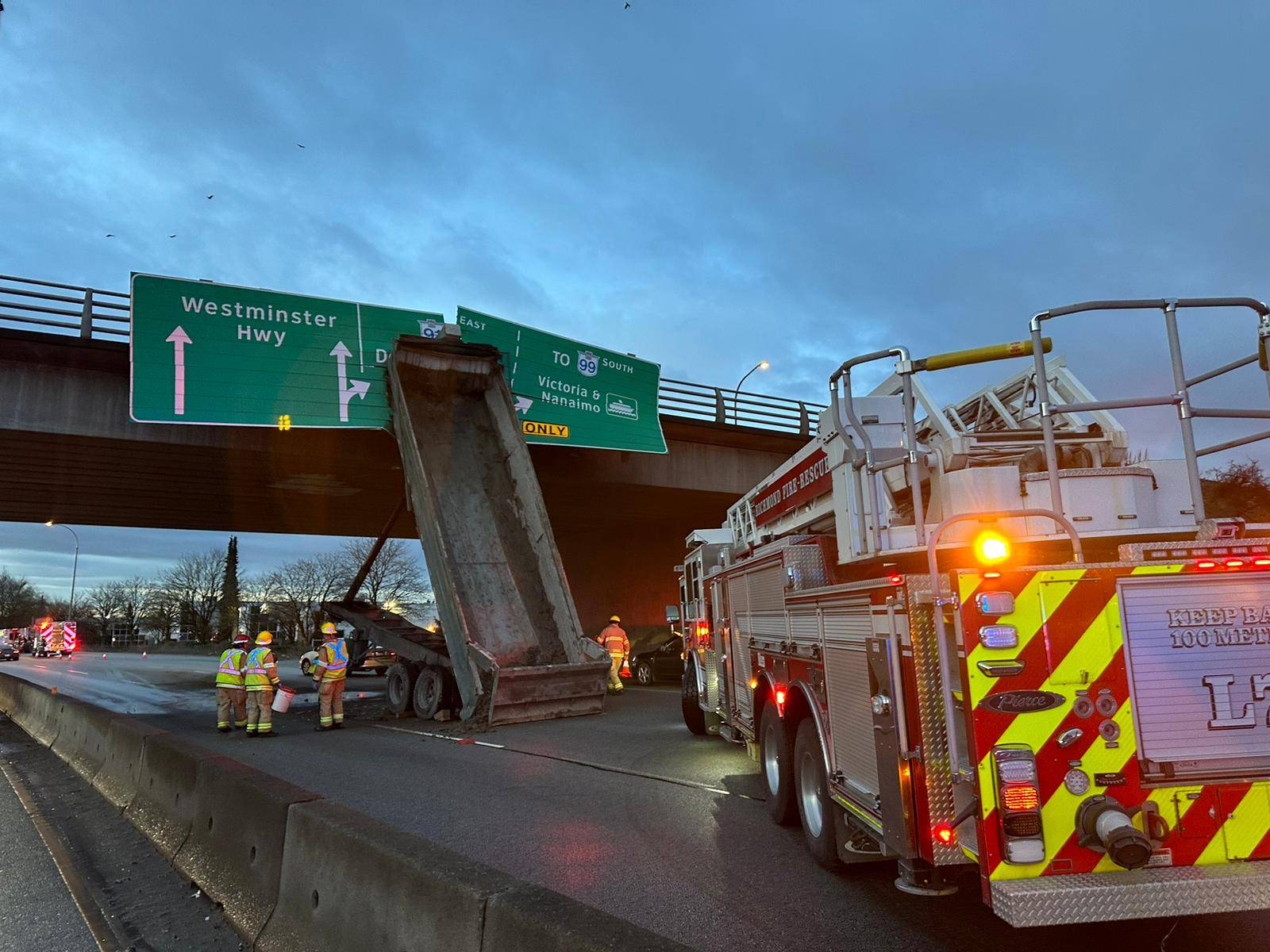
Early on a Friday morning in Richmond, British Columbia, a commercial truck collided with the Cambie Road overpass on Knight Street, causing major traffic disruption and raising serious questions about road safety and infrastructure resilience. The incident involved a truck hauling a dump trailer with its bed stuck in a fully raised position, which failed to clear the bridge and struck the structure with significant force. While no injuries were reported, the crash led to the closure of a key transportation corridor and renewed public and industry attention on a pattern of similar collisions in the region.
What Happened on Knight Street
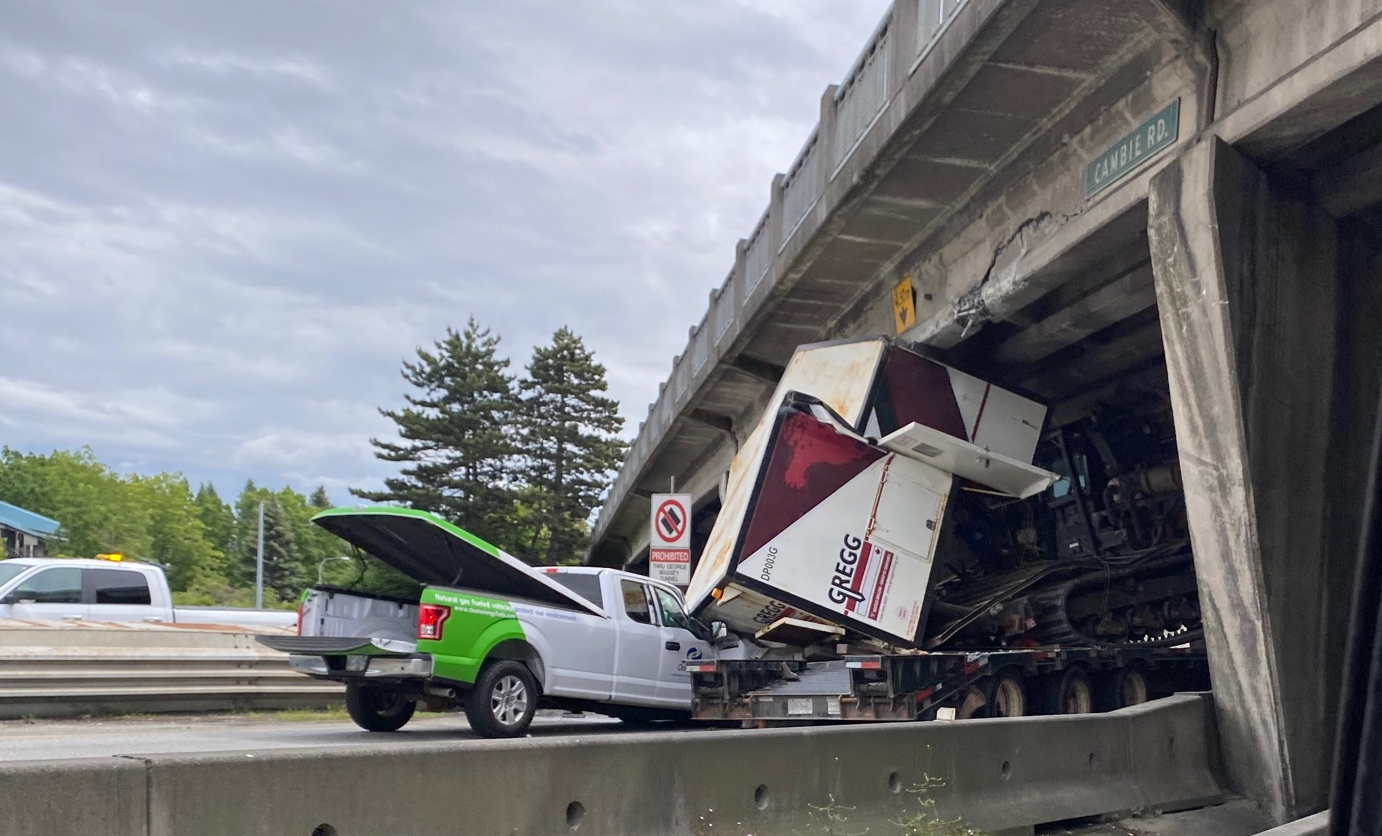
According to local authorities and transport officials, the collision occurred at approximately 7:15 a.m., during the busy morning commute. The truck was travelling southbound on Knight Street, a critical north–south arterial route that connects Vancouver, Richmond, Delta, and the broader Fraser Valley. As the vehicle approached the Cambie Road overpass, its dump trailer remained in a fully elevated position, reportedly high enough to exceed the bridge’s vertical clearance.
When the raised trailer struck the overpass, the impact was strong enough to lodge part of the metal structure into the concrete of the bridge. The truck’s cab separated from the trailer, coming to rest further down the roadway. Debris and damaged components were scattered across multiple lanes. Emergency crews, police, and highway maintenance staff quickly arrived on scene, and southbound Knight Street traffic was shut down to protect motorists and allow for an initial safety assessment.
Despite the dramatic nature of the crash, officials confirmed that no serious injuries were reported. The absence of casualties has been widely described as fortunate, given the volume of traffic and the potential for secondary collisions in similar incidents.
Immediate Response and Structural Assessment
Following the crash, the Richmond Road Safety Unit assumed control of the investigation, working closely with the British Columbia Ministry of Transportation and Infrastructure. Structural engineers were dispatched to examine the Cambie Road overpass and the Knight Street Bridge corridor to determine whether the bridge had sustained short-term or long-term damage.
Engineers typically begin such assessments with visual inspections, looking for obvious indicators such as spalling concrete, exposed reinforcing steel, distorted beams, or misaligned joints. In cases of significant impact, however, the analysis goes further. Officials may employ non-destructive testing methods, including ultrasound, ground-penetrating radar, or detailed load calculations, to identify hidden internal damage that cannot be seen with the naked eye.
Specialists involved in similar incidents in British Columbia and other jurisdictions note that even when a bridge appears outwardly intact, the energy from an over-height collision can create hairline fractures, stress reinforcement bars, and loosen crucial connections. For this reason, transportation agencies often keep affected structures under monitoring for some time after an impact, and in some cases, impose temporary load or speed restrictions until more extensive evaluations are completed.
A Pattern of Overpass Collisions in British Columbia
The Richmond incident is part of a broader pattern that has drawn growing concern from policymakers, engineers, and the trucking sector. Over recent years, British Columbia’s Lower Mainland and Fraser Valley have reported multiple cases of commercial vehicles striking bridges and overpasses. Several of these incidents have involved dump trucks or trailers with elevated beds that were not lowered before drivers entered routes with restricted clearances.
Local media and provincial authorities have previously reported that in one recent year, a truck–overpass collision in Langley marked the eighth such incident on provincial highways within a 12-month period. While the circumstances differ case by case, investigators have repeatedly identified similar underlying factors: failure to lower truck beds or booms, inaccurate assumptions about load height, and a lack of careful attention to overhead clearance signage.
Driver error plays a central role in many of these collisions, but experts emphasize that broader systemic issues can contribute as well. Aging infrastructure, resurfaced roadways that subtly change clearance heights, and damaged or faded signage can all combine to increase risk. Each major collision not only disrupts traffic but also carries potentially high costs for inspections, repairs, and future monitoring.
Safety Concerns and Engineering Perspectives
From an engineering standpoint, a heavy vehicle impacting an overpass is a serious event even when visible damage seems limited. Bridges are designed to withstand specific load conditions and environmental stresses, but strong localized impacts can introduce forces that were not fully contemplated in original design calculations, especially on structures built decades ago under older codes.
Experts in bridge engineering note that high-energy collisions can:
- Introduce micro-cracks in concrete that may propagate over time.
- Damage or yield steel reinforcement, reducing overall capacity.
- Shift bearings or joints that are essential for accommodating thermal expansion and movement.
- Compromise protective coatings, accelerating corrosion if not addressed.
Because of these potential impacts, transportation agencies typically treat each collision as a trigger for a detailed review. In some jurisdictions, bridges that have experienced repeated over-height strikes may be prioritized for strengthening, geometric modifications, or the installation of protective devices such as sacrificial beams that take the impact before the main structure.
Economic and Traffic Impacts on the Region
The temporary closure of southbound Knight Street after the Richmond crash had immediate effects on traffic flows across the Metro Vancouver area. Knight Street is one of the primary freight corridors linking Vancouver’s industrial zones, the Port of Vancouver, the Vancouver International Airport vicinity, and distribution centers in Richmond, Delta, and beyond. When such a route is suddenly disrupted, delays ripple quickly through supply chains.
Transport companies reported detours onto alternative crossings and secondary roads, adding distance and time to regular routes. Longer travel times contribute to increased fuel consumption and labour costs. Businesses that rely on just-in-time deliveries, particularly in sectors such as food distribution, construction materials, and retail, may experience short-term supply bottlenecks when key links are blocked even for a few hours.
For commuters, the closure translated into longer queues on parallel routes, such as the Oak Street Bridge and the Arthur Laing Bridge, as drivers sought alternate paths between Richmond and Vancouver. Municipal traffic management centers typically respond to such events by adjusting signal timing, updating roadside message boards, and issuing advisories through media and social channels. Nevertheless, the Richmond case illustrates how a single incident involving one truck can affect thousands of daily trips and impose significant, if temporary, economic costs.

Industry and Advocacy Group Responses
Industry organizations, including the British Columbia Trucking Association (BCTA), have been increasingly vocal about preventing overpass collisions. The BCTA and similar groups across Canada and the United States advocate for a combination of technological upgrades, stricter operational practices, and improved infrastructure to reduce the frequency of such events.
One widely discussed solution is the installation of over-height detection systems on approaches to critical bridges and tunnels. These systems, used in several North American and European cities, employ laser, infrared, or radar sensors to measure the height of approaching vehicles. If a vehicle exceeds the safe clearance, the system triggers flashing signs or audible alarms to warn drivers to stop or divert before they reach the structure.
Trucking advocates also stress the importance of comprehensive driver training. Recommended measures include:
- Mandatory verification of trailer or equipment height before departure.
- Standardized procedures for stowing hydraulic and mechanical equipment.
- Regular refreshers on reading and interpreting clearance signage.
- Encouraging a safety culture where drivers are empowered to stop and check equipment whenever they are uncertain.
In addition, some fleet operators are increasingly turning to telematics and GPS-based fleet management systems. These tools can record route histories, flag recurring “hot spots” where over-height risks or previous collisions have occurred, and, in some advanced setups, integrate with mapping data that includes bridge clearances. While such technologies are not yet universal, they are becoming more common as operators seek to reduce risk and insurance costs.
Policy Debate and Aging Infrastructure
The Richmond collision has contributed to ongoing discussions about the state of transportation infrastructure in Canada and the need to modernize bridges and highways in step with rising freight volumes. Many of the country’s major bridges were constructed in the mid to late 20th century and are now subject to heavier and more frequent truck traffic than originally anticipated.
Policymakers and infrastructure experts point to several potential policy directions:
- Mandatory over-height detection on major corridors: Requiring sensors and automated warnings on routes with a history of collisions or critical regional importance.
- Improved data integration: Developing national or provincial databases of bridge and tunnel clearances and integrating them into commercial vehicle navigation systems to reduce reliance on roadside signs alone.
- Enhanced signage and maintenance: Ensuring that clearance signs are prominent, reflective, and maintained, particularly after resurfacing or structural work that might change effective heights.
- Transparency and public reporting: Publishing detailed statistics on overpass strikes, repair timelines, and costs, to inform public debate and help prioritize investments.
In other countries, similar challenges have led to a mix of technological and regulatory solutions. For example, some European highways use gantries with hanging bars or warning frames that are struck before an overpass, giving both an audible and visual alert long before a vehicle reaches a vulnerable structure. In the United States, state departments of transportation maintain online maps and apps indicating low-clearance routes, which are increasingly being tied into commercial trucking navigation systems.
Lessons for Safety and Prevention
The Richmond event underscores several key lessons for both the public and private sectors. For government authorities, proactive prevention is generally far less costly than post-incident repair and investigation. Investments in detection systems, signage, and digital mapping can reduce the likelihood of collisions and preserve the lifespan of critical infrastructure.
For the trucking industry, the case serves as a reminder that strict adherence to safety protocols is essential. Detailed pre-trip inspections, checklists for hydraulic and mechanical equipment, and a work culture that prioritizes safety over schedule pressures can all reduce the risk of oversight. Companies that invest in driver education, modern telematics, and clear internal policies may also benefit from reduced downtime and insurance claims.
From a broader societal perspective, the Richmond crash illustrates the interconnected nature of urban infrastructure. A single misjudgment involving one vehicle can affect emergency services, commuters, businesses, and regional trade. While the absence of injuries in this case is encouraging, each such event offers an opportunity to review systems, close gaps, and enhance resilience across the transportation network.

Looking Ahead
As detailed engineering assessments of the Cambie Road overpass proceed and any necessary repairs are completed, attention is likely to remain focused on preventing similar incidents. Coordinated efforts between municipal governments, provincial transportation agencies, industry associations, and individual carriers will be important to designing and implementing effective, long-term solutions.
Modernizing infrastructure, leveraging technology for early warning and route planning, and maintaining strong safety cultures within the trucking sector are complementary strategies rather than alternatives. Together, they can help ensure that vital corridors like Knight Street remain safe, reliable, and efficient for the thousands of people and businesses that depend on them each day.
Sources
- Reuters – Canada transport and infrastructure coverage
- BBC News – Transport and infrastructure reports
- The Guardian – Canada news and analysis
- CBC News – British Columbia local reporting
- Government of British Columbia – Ministry of Transportation and Infrastructure
- British Columbia Trucking Association – Safety and policy resources
