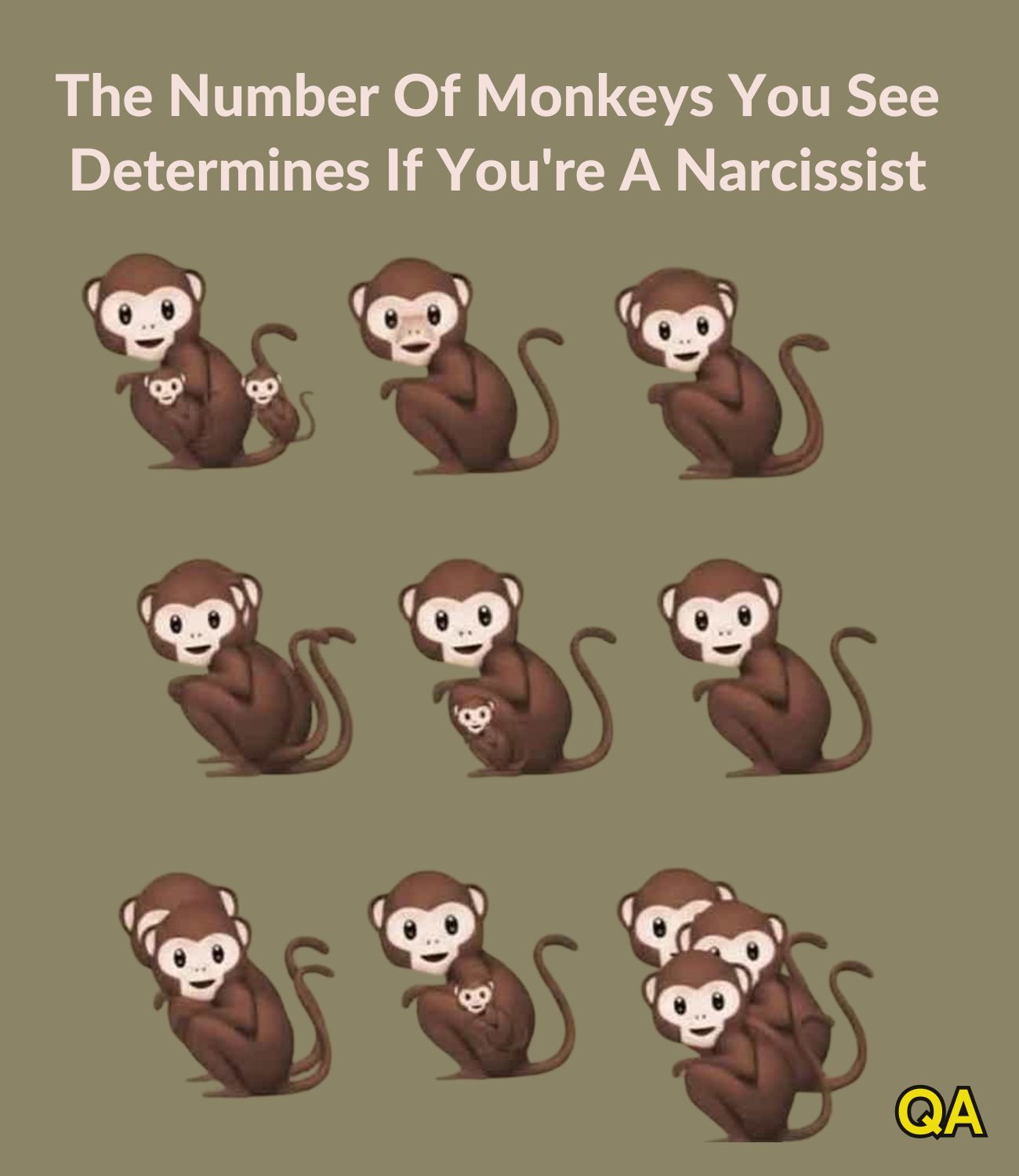

It starts innocently enough. You are scrolling through your feed when a playful image catches your eye. Rows of smiling cartoon monkeys sit against a plain background, inviting you to take a closer look. At the top, a bold statement appears: “The number of monkeys you see determines if you’re a narcissist.”
You pause.
Almost instinctively, you begin counting.
At first, the answer seems obvious. You spot a handful of monkeys, each clearly outlined. But then, something shifts. Your eyes linger a little longer, and suddenly, more shapes begin to emerge. Smaller monkeys appear hidden within larger ones. Overlapping forms reveal patterns you didn’t notice before. What once seemed simple now feels surprisingly complex.
You count again.
And just like that, a lighthearted image transforms into a moment of curiosity, reflection, and even mild confusion. But what is really going on here? Is there any truth behind the claim, or is something else at play?

The Viral Claim: Can a Puzzle Reveal Personality?
The idea that a visual puzzle can reveal deep personality traits is undeniably appealing. It taps into a universal desire to understand ourselves better. The suggestion that something as simple as counting monkeys could uncover traits like narcissism makes the experience feel meaningful and personal.
However, from a scientific standpoint, this claim does not hold up.
There is no credible psychological evidence that the number of figures you perceive in an image can diagnose or indicate narcissism. Personality traits, especially complex ones like narcissism, are typically assessed through structured evaluations, validated questionnaires, and long-term behavioral patterns. A single visual task cannot provide such insights.
This does not mean the puzzle is meaningless. It simply means its value lies elsewhere.
Why You See Different Numbers
The real fascination of the monkey illusion lies in how different people perceive it differently. Some viewers quickly identify a fixed number of monkeys and feel confident in their answer. Others continue scanning the image, discovering hidden shapes and revising their count multiple times.
This variation is not random. It reflects how the human brain processes visual information.
The Brain as an Interpreter
Contrary to popular belief, the brain does not function like a camera that passively records reality. Instead, it actively interprets what it sees. It organizes shapes, prioritizes certain details, and fills in missing information based on prior experience.
This process involves several key mechanisms:
Selective attention determines what stands out first. Your brain decides which elements deserve immediate focus and which can be ignored.
Pattern recognition allows you to identify familiar shapes quickly, even when they are partially hidden or abstract.
Cognitive shortcuts, also known as heuristics, help your brain process information efficiently but can sometimes lead to oversimplified interpretations.
Because these processes differ slightly from person to person, it is natural that individuals arrive at different answers when viewing the same image.
Big Picture Thinkers vs Detail-Oriented Observers
One way to interpret the differences in perception is through cognitive style. While not absolute categories, people often lean toward one of two general tendencies.
Some individuals naturally focus on the overall structure of an image. They quickly identify the most prominent shapes and feel satisfied with their initial interpretation. This approach emphasizes efficiency and broad understanding.
Others are more inclined to examine finer details. They look beyond the obvious, searching for hidden patterns and subtle variations. This approach prioritizes thoroughness and curiosity.
Neither style is better than the other. In fact, both are valuable in different contexts. Big picture thinking is useful for making quick decisions and understanding general trends, while detail-oriented observation is essential for tasks that require precision and careful analysis.
The monkey illusion simply highlights these differences in a playful way.

The Role of Expectations and Suggestion
Another important factor influencing what you see is expectation. When you read the statement about narcissism, it primes your brain to treat the puzzle as something meaningful. This can subtly influence how you approach the image.
You may spend more time analyzing it than you normally would. You may second-guess your initial answer, wondering if there is a “correct” number you are supposed to find. This heightened attention increases the likelihood that you will notice additional details.
In psychology, this is related to the concept of top-down processing. Your expectations, beliefs, and prior knowledge shape how you interpret incoming information. In this case, the suggestion that the puzzle reveals something about you encourages deeper engagement.
Why These Illusions Go Viral
Puzzles like the monkey illusion spread rapidly across social media, and their popularity is not accidental. They are carefully designed to trigger a sequence of reactions that keep people engaged.
First comes curiosity. The bold claim makes you want to test it for yourself.
Next comes self-reflection. You begin to wonder what your answer might reveal about you.
Finally, there is comparison. You become interested in how your result compares to others.
This combination creates a powerful loop of engagement. People are not just looking at an image; they are participating in a shared experience. They comment, share, and discuss, turning a simple puzzle into a social phenomenon.
Cultural Significance of Visual Puzzles
Visual illusions and puzzles have existed for centuries, long before the rise of social media. They appear in art, literature, and folklore across cultures. From hidden images in classical paintings to optical illusions in modern design, these creations reflect a timeless fascination with perception.
In many cultures, such puzzles are seen as more than entertainment. They are often viewed as tools for sharpening the mind or encouraging deeper observation. They remind us that reality is not always as straightforward as it appears.
The monkey illusion fits into this broader tradition. While its modern presentation is shaped by digital culture, its underlying appeal is rooted in a long history of human curiosity about perception.
Scientific Perspectives on Optical Illusions
From a scientific perspective, optical illusions are valuable because they reveal how the brain works. By studying how people interpret ambiguous images, researchers can gain insights into perception, attention, and cognition.
Illusions demonstrate that perception is not a direct reflection of reality. Instead, it is a constructed experience shaped by neural processes. This is why two people can look at the same image and see different things.
In the case of the monkey puzzle, the illusion relies on overlapping shapes and repeating patterns. These elements create ambiguity, allowing the brain to interpret the image in multiple ways. The longer you look, the more likely you are to notice alternative interpretations.
This does not indicate anything unusual or abnormal. It is simply a natural outcome of how perception works.
The Myth of Instant Personality Tests
The idea that quick visual tests can reveal personality traits is a common theme in online content. While entertaining, these claims should be approached with caution.
Personality is complex and influenced by many factors, including genetics, environment, and life experiences. Reliable assessments require carefully designed methods and consistent measurement over time.
Simple puzzles, on the other hand, are influenced by momentary factors such as attention, mood, and context. They can provide interesting insights into how you think in a specific moment, but they cannot define who you are.
Recognizing this distinction allows you to enjoy these puzzles without overinterpreting their results.

What the Monkey Puzzle Can Teach You
Result: 18 monkeys
Even without the dramatic claims, the monkey illusion still offers something valuable. It encourages you to slow down and look more carefully. It reminds you that first impressions are not always complete.
It also highlights the diversity of human perception. Each person brings a unique perspective to the same image, shaped by their experiences and cognitive tendencies.
In a world that often emphasizes quick judgments and immediate answers, taking a second look can be surprisingly powerful. It opens the door to new insights and deeper understanding.
A Reflection on Human Curiosity
At its core, the popularity of the monkey illusion is not about monkeys or personality labels. It is about curiosity.
Humans are naturally drawn to mysteries, even small ones. We enjoy the challenge of figuring things out, especially when the answer is not immediately obvious. We are also deeply interested in ourselves, always looking for clues that might help us better understand who we are.
This combination makes puzzles like this irresistible. They offer a moment of discovery, a chance to reflect, and an opportunity to connect with others.
So the next time you encounter a similar image, take a moment to appreciate it for what it is. Not a test with a definitive answer, but a reminder that perception is flexible, attention is selective, and there is often more to see than meets the eye.
And if you find yourself counting again, that is perfectly natural.
After all, curiosity is one of the most defining traits we share.
Sources
American Psychological Association. Visual perception and cognitive processes.
National Institutes of Health. Studies on attention and pattern recognition.
British Psychological Society. Understanding cognitive biases and heuristics.
Stanford Encyclopedia of Philosophy. Theories of perception and interpretation.
Verywell Mind. How optical illusions reveal brain function.
